
Insights / Cloud & DevOps
Build artifact traceability: trace every production deploy back to its source
When production misbehaves, “which code is running?” should take seconds to answer. Traceable artifacts link every deploy to its source commit, its tests, and its approvals.
Kiran Bandarupalli · 27 Oct 2026 · 6 min read
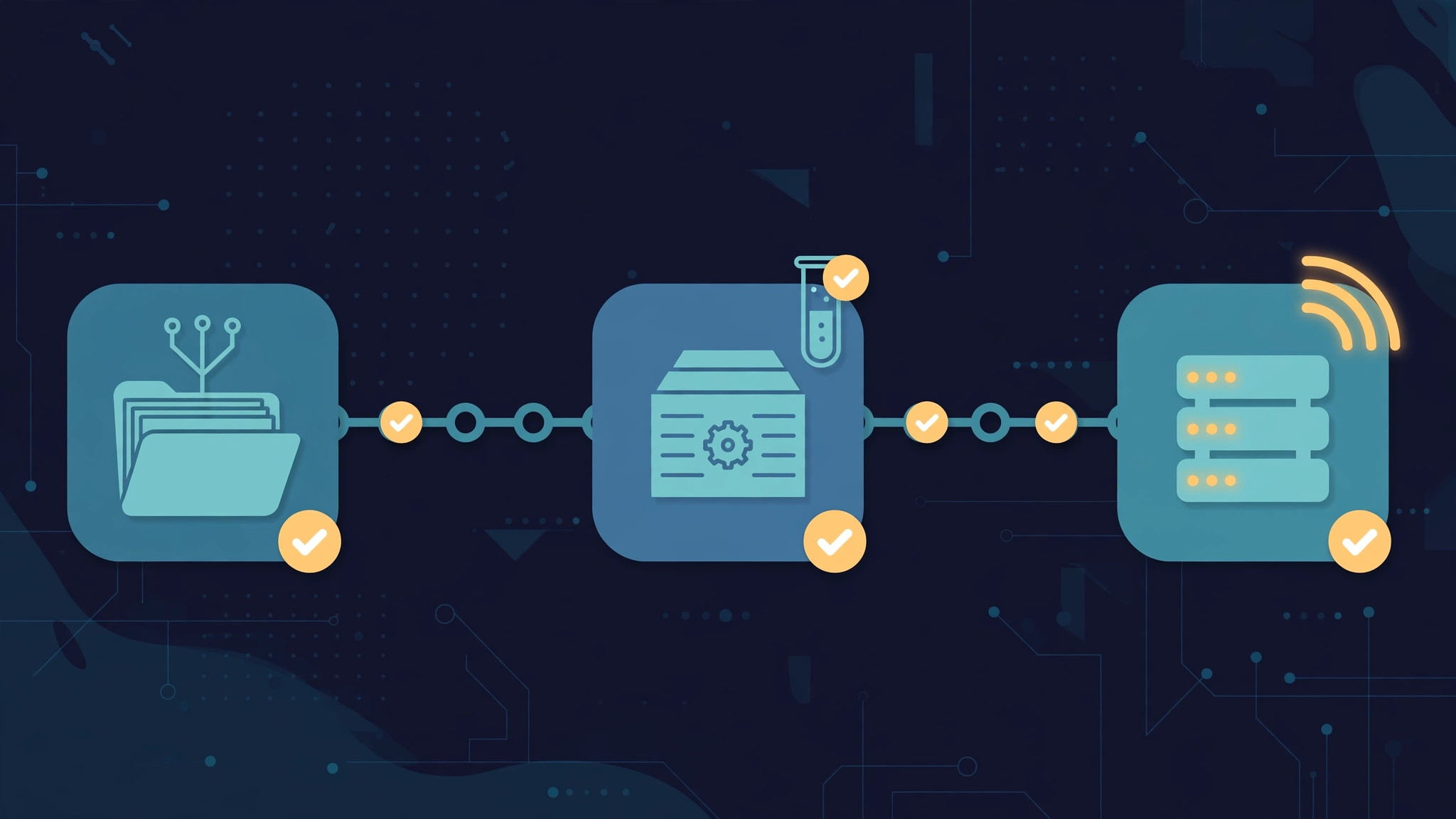
Sooner or later, every team faces the same uncomfortable question in production: which code is actually running right now, and where did it come from? If the answer requires digging through chat logs, guessing which branch was built, or rebuilding from memory, the team does not have a release process problem. It has a traceability problem. A traceable artifact carries its own history: the reviewed commit that produced it, the tests that passed, and the environment it was promoted into.
Traceability is what makes incident response fast, rollbacks safe, and audits boring. When a vulnerability is announced, a traceable fleet can say in minutes which services contain it. The work is discipline at build time, not heroics at incident time.
What traceability actually means
An artifact is traceable when four questions each have one authoritative answer. What source produced it? What was verified about it? Where has it been deployed? What changed since the previous artifact? If any answer lives only in someone's head, the chain is broken.
This is stricter than having a version number, which can be reused while branches move and tags are force-pushed. A useful identity is immutable: the same identity always refers to the same bytes. That is why a deployment pipeline should prove what it ships rather than merely report a green build.
Give every artifact an identity it cannot lose
Start with a content-addressed identity: a digest of the artifact itself, recorded with the commit, the build definition, and the toolchain versions. Two artifacts with the same digest are the same artifact; two with different digests are not, whatever their labels say.
Build once and promote the same artifact through every environment. Rebuilding for production from the same branch is the most common way traceability breaks silently, because the production binary is then not the binary that passed staging tests. Promotion should move the artifact, not rebuild it.
{
  "artifactDigest": "sha256:9f2c…",
  "sourceCommit": "a1b2c3d",
  "buildDefinition": "pipeline/release.yml@a1b2c3d",
  "testReport": "reports/build-4821",
  "sbom": "sbom/build-4821.json",
  "deployedTo": "production"
}
A record like this needs to be automatic and stored away from the build machine that produced it; a manual step will be skipped exactly on the rushed release where it matters most.
Record provenance at build time, not at release time
Provenance is the record of how an artifact came to be: its source, build steps, dependencies, and tools. Capture it during the build, when the facts are available and verifiable. Retrofitting it after a release means reconstructing facts from logs that may be gone, which is how plausible-but-wrong histories get written.
A software bill of materials, or SBOM, is the dependency half of provenance. It lists the components inside the artifact so a vulnerability announcement can be matched against the fleet instead of against guesswork. Generated as part of the build, it costs little and pays for itself the first time a critical CVE lands. Keep the SBOM with the artifact so an old artifact's SBOM is still available when an old vulnerability resurfaces.
Where risk justifies it, add a signature or attestation. Signing says who built the artifact; attestation says what the build did. For internal tools, a digest plus an access-controlled build history may be enough. For software shipped to customers or regulators, signed attestations that the deployment system verifies before promotion are worth the setup. The deployment gate should refuse an artifact whose provenance is missing, not merely warn about it.
The deployment ledger: what is running where
Provenance answers where an artifact came from. A deployment ledger answers where it went. For each environment it records the digest currently running, when it was deployed, what it replaced, and which approval or policy allowed the promotion. With that record, “what changed in the last deploy?” becomes a lookup, not an investigation.
The ledger also makes rollbacks trustworthy. Rolling back only helps if the team knows exactly which artifact it is returning to, including its database compatibility. Deploying database changes without a maintenance window works only when each artifact stays compatible with the schema it may run against; restoring old code against a new, incompatible schema trades one outage for another. Record schema versions alongside artifact versions so a rollback decision can check compatibility first.
Keep the ledger close to the systems that already observe production: observability for asynchronous workflows only helps if deploy records can be correlated with the errors and latency that followed them, so let deploy events carry the artifact digest into dashboards and alerts.
The traceability checklist
- Every artifact has a content digest, recorded with its source commit, build definition, and toolchain versions.
- The same immutable artifact is promoted through staging to production; production never rebuilds from a branch.
- An SBOM is generated at build time and stored with the artifact, not reconstructed later.
- Test reports are linked to the artifact digest, so “tested” means tested on these exact bytes.
- A deployment ledger records, per environment, the running digest, its predecessor, its approval, and its schema version.
- Deployment gates refuse artifacts with missing provenance instead of merely warning about them.
- Provenance, SBOMs, and the ledger are retained longer than build logs, and survive the build machine.
- Any engineer on call can answer “what is running, and what changed?” without asking the person who deployed it.
Teams adopting this usually find one weak link quickly, and often it is retention: build logs expire after days, while “what shipped in March?” arrives months later.
When something goes wrong, trace backwards in minutes
Consider two versions of the same incident. In the first, an alert fires and nobody can say which artifact is running, so the team spends the first hour reconstructing history while the incident continues. In the second, the alert carries the artifact digest, the ledger shows the previous digest and the diff between them, and the SBOM shows whether a disclosed vulnerability is present. The second team still has an incident, but a bounded, factual investigation instead of an open-ended one.
Be honest about the cost. Provenance, SBOM storage, signing, and retention add moving parts, and a small team should not build a compliance platform before it needs one. That is where platform engineering for a small team earns its keep: the machinery should live in the shared platform once, so each service gets digests, SBOMs, and ledger entries by default.
Boundaries make traceability easier, not harder
Traceability is easier when the unit being traced is well bounded. A service that does one job has one artifact, one SBOM, and one deploy record, while a sprawling component produces a diff that means nothing because everything changed at once. That is one practical reason to take operational boundaries seriously when choosing between a monolith and microservices.
A team that already runs cloud and DevOps infrastructure with repeatable pipelines can add digests and a deployment ledger as pipeline features, not as a separate project. The pipeline already knows the commit, the tests, and the target environment. An artifact that can prove where it came from, what was tested, and where it went turns incidents, disclosures, and audit questions from investigations into lookups. If your team cannot answer “which code is running?” in under a minute today, that is the first gap to close — and if you want help putting digests, provenance, and a ledger into your pipeline, talk to BDOT Software about your release process.